Independent · For your home · We don't sell panels
Get your solar ruling before you sign.
Before you spend $20,000+ on solar, shouldn't you spend $129 to see if it'll even work? SolarRuling measures your roof, subtracts the fire-code setbacks, scores the shade, and runs the savings against your own electric bill at your local rates. Then it tells you plainly: worth it, maybe, or not worth it.
- Built for your exact address
- Your local electricity rates
- No sales pitch, no installer referrals
Solar salesman at your door? Get an independent answer first.
Why get a ruling first
Is solar worth it on your home? Find out for $129.
A solar quote is written by someone who wants to sell you a system. A ruling is written for you. Here's what you get to see before you sign anything.
An independent second opinion
Line up the installer's numbers against your own. System size, yearly production, payback: if the quote and the ruling disagree, you'll know which questions to ask.
What your home can actually produce
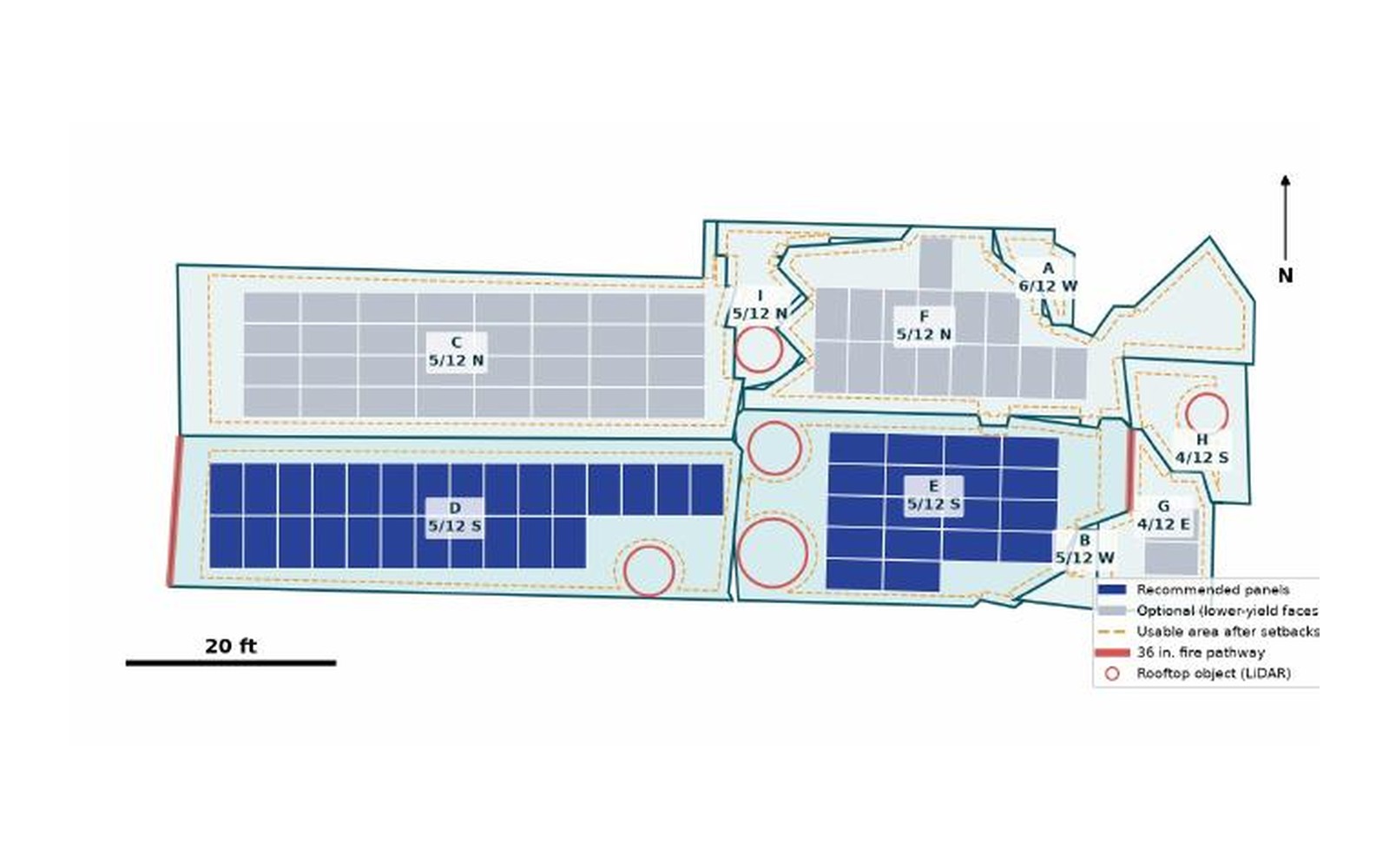
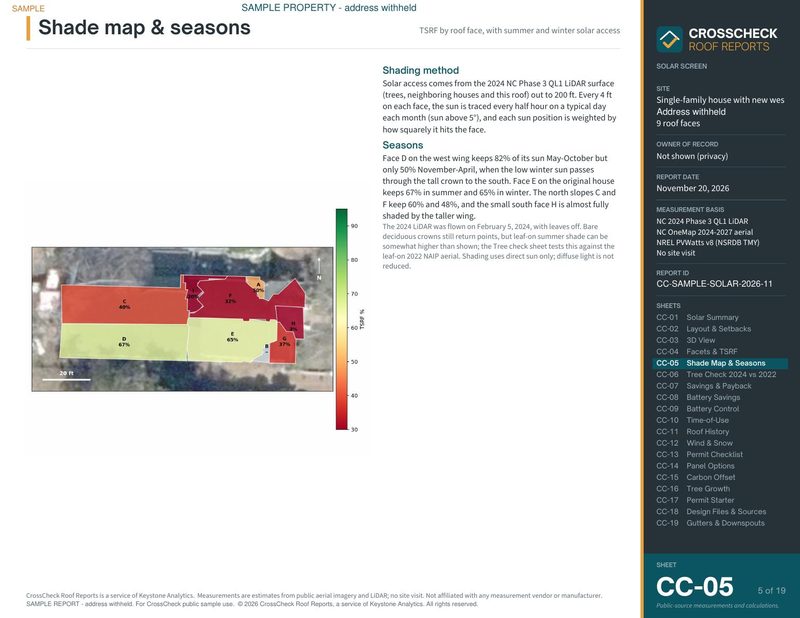
Your report shows the panel layout that really fits and the shade map behind it, side by side, so the production number makes sense at a glance.
Sunny from the street isn't the same as sunny on paper
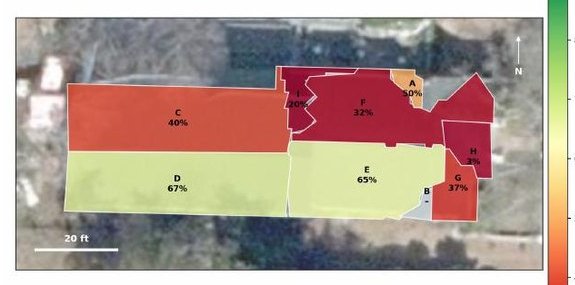
A roof can look bright from the driveway and still be a weak place for solar. Every roof face gets a shade score from measured tree and obstruction heights.
Measured roof, minus fire setbacks
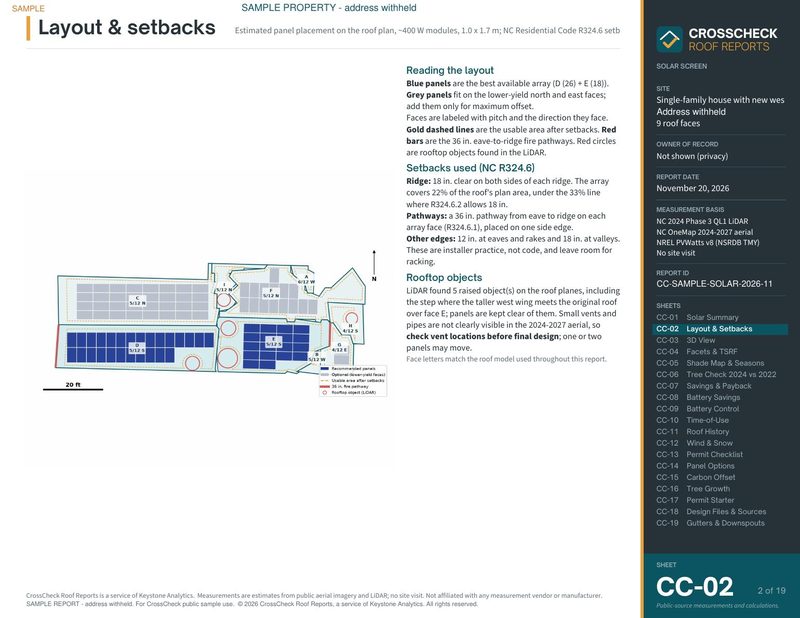
Fire-code pathways at ridges and edges come off first. Panels are placed only on the area that's left, so the panel count is one that can actually be built.
Your bill, your production, your payback
Tell us your average monthly electric bill. Savings and payback are based on your actual bill at your local utility's rate, not a national average.
The cheapest step in going solar
Spend $129 to know whether the next $20,000 makes sense. If the answer is yes, you walk into every quote with your own numbers.
How it works
Your address in. Your ruling out.
Enter your address and your bill
Pin your home on the map, choose our area estimate or enter your average monthly electric bill, and tell us where to send the report. Pay securely by card.
We measure and model
Your roof is measured from government LiDAR and aerials. We lay out panels after setbacks, score the shade, estimate production, and compare it with your actual usage for savings based on your bill, not an average.
Read your ruling
Within 24 hours (or about 4 with Rush), you get a full PDF report with a plain-English summary on page one, plus design files.
The verdict
Worth it, maybe, or not worth it, with the reasons.
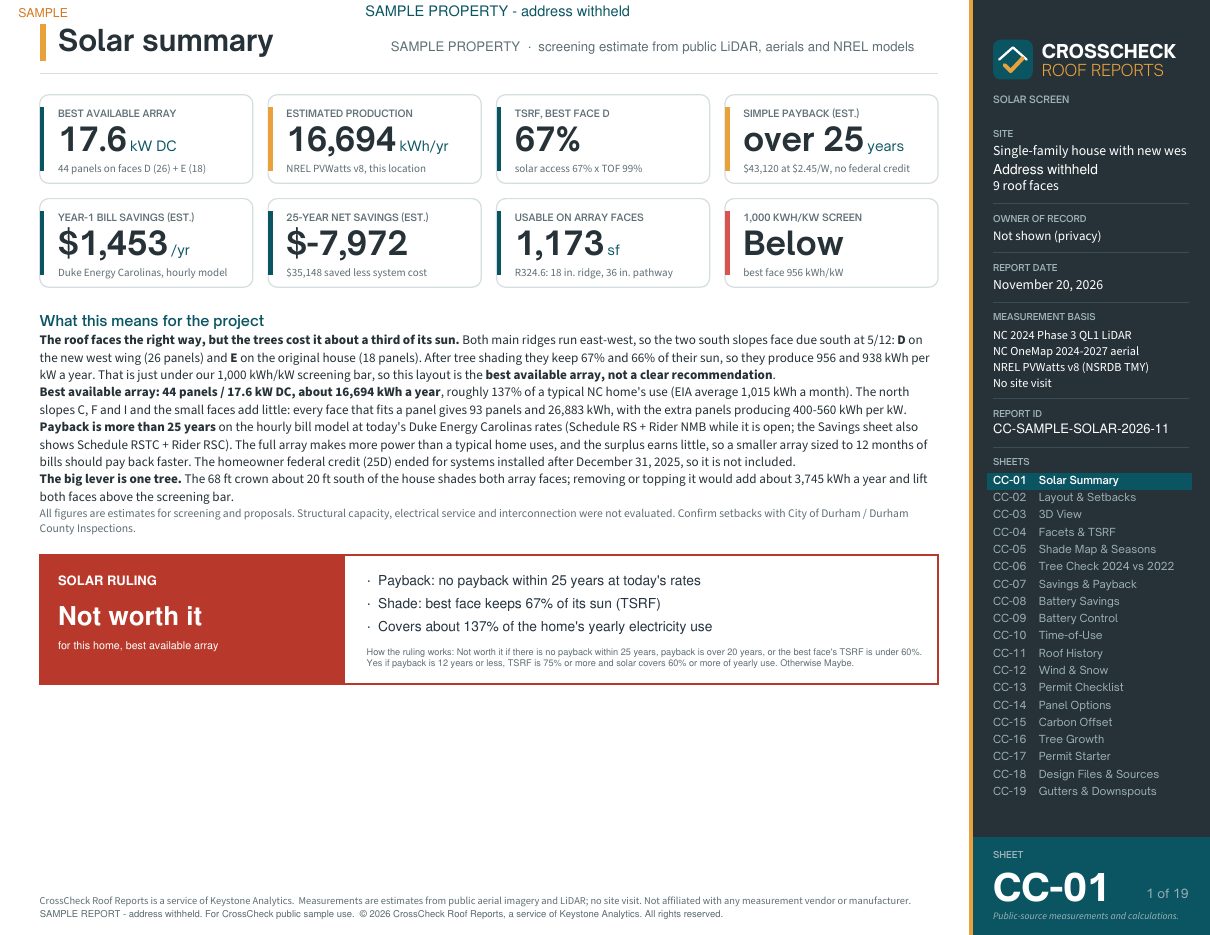
Page one of your report carries your Solar Ruling in plain English, with the three numbers behind it: payback, shade and how much of your electricity use solar covers.
Yes, worth it
- Roof faces point the right way
- Strong sun after shade
- A layout that fits after setbacks
- Payback that works at your rates
Maybe, with changes
- A smaller system sized to your bills
- Only the best roof faces used
- One tree or obstruction making the difference
- Know what to change before you buy
Not worth it
- Too much shade on the usable faces
- Too little room after setbacks
- Payback too long at your rates
- Keep your $20,000+
How the ruling works: Yes when payback is 12 years or less, the best roof face keeps 75% or more of its sun, and solar covers 60% or more of your use. Not worth it when there's no payback within 25 years, payback runs past 20 years, or the best face keeps under 60% of its sun. Everything in between is Maybe. A "not worth it" ruling is just as valuable as a yes. It's the one that saves you the most money.
Check your installer's quote
Don't sign until you check.
Your installer's estimate vs. what your home can actually produce. Put the two side by side before you commit.
| System size | ___ kW |
| Yearly production | ___ kWh |
| Roof faces used | ? |
| Shade assumed | ? |
| Electric rate used | ? |
| Payback | ___ years |
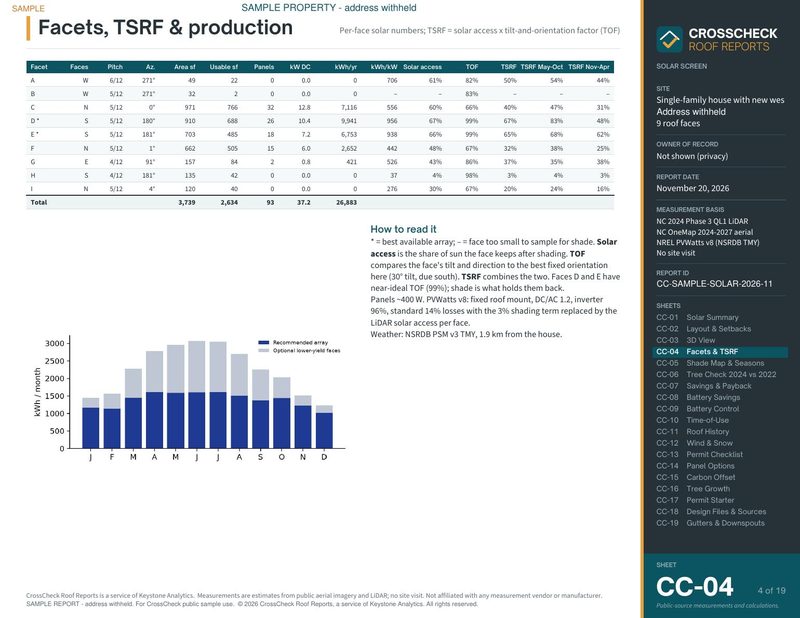
| Best available array | 17.6 kW DC, 44 panels |
| Estimated production | 16,694 kWh/yr |
| Roof faces used | Two south faces, 5/12 |
| Shade score, best face | 67% TSRF |
| Electric rate used | Local utility, hourly model |
| Simple payback | Over 25 years |
Sample figures are for that one property. Your report uses your roof and your local utility's rates.
The shade reveal
In our sample, both main roof faces pointed due south. Looks perfect. The shade scoring showed trees were taking about a third of their sun, and the full system came out at a payback of more than 25 years.
That's the kind of answer you won't get from a sales visit.
Before the salesman leaves
3 questions to ask before you sign a solar contract
Write these down. Your ruling gives you your own answers to compare.
"How many kWh a year will this produce, and how much shade did you assume?"
Production drives every savings number on the quote. Compare it with your report's estimate for the same roof faces.
"Which roof faces are the panels on, and do they clear the fire setbacks?"
Panels on north faces or crowded into setback pathways change the picture. Your report shows the usable area face by face.
"What electric rate and incentives did you use for the payback?"
Ask whether the payback counts on a tax credit or rate you may not get. Your report runs payback at your local utility's rates.
And three more worth asking
- How much life is left on my roof, and who pays to remove and reinstall the panels when it's replaced?
- Who stands behind the roof attachments and the flashing around them?
- Would a smaller system sized to my bills pay back faster?
What's in your ruling
A full solar report for your home, not a sales flyer.
A detailed PDF report plus design files, built for your exact address.
Measured roof, face by face
Every roof face measured from government LiDAR, with area, pitch, direction, and the height of chimneys, vents and other obstructions.
Usable area after fire setbacks
Ridge and pathway setbacks come off first, so you see the roof area panels can really use.
Panel layout that fits
An estimated panel layout and best available array, drawn on your roof, with the panel count and system size.
Shade scoring (TSRF)
Solar access and TSRF for every roof face, plus a shade map by season, so you know which faces earn their keep.
Production estimate
Yearly and monthly production from the national PVWatts model with local weather data for your location.
Tree change across the years
Tree coverage compared across years of government aerials, so you see how shade around your home has changed.
Savings based on your actual bill
Your monthly bill is turned into yearly usage at your local utility's rate, then compared with your home's production: how much of your bill solar covers, what you save, and your payback. Battery and time-of-use views included.
Permit checklist and starter
Your local permit office links and requirements, plus a permit starter sheet with your site plan and array data.
Design files included
DXF, GeoJSON and JSON files with the roof faces, usable area and panel layout, ready to hand to any designer or installer.
See a sample
Look inside a real report.
A complete sample report for a single-family home. Address withheld.
- Pages
- 19
- Files
- PDF + DXF + GeoJSON + JSON
- Price
- $129 per home
- Delivery
- Within 24 hours
One simple price.
Your solar ruling
per home · delivered within 24 hours
- Plain-English ruling on page one
- Measured roof and usable area after fire setbacks
- Panel layout and best available array
- Shade scoring and tree change across years
- Savings and payback based on your actual electric bill
- Permit checklist and permit starter
- DXF, GeoJSON and JSON design files
Rush +$15 for about 4-hour delivery, same day when ordered by 2 PM ET. Secure checkout through our report partner, CrossCheck Roof Reports.
FAQ
Questions homeowners ask
Is solar worth it for my home?
It depends on your roof faces, your shade, how much usable area is left after fire setbacks, and your local electricity rates. Your SolarRuling report checks all of those for your exact address and gives you a plain-English call, with the numbers behind it.
Do you sell solar panels or work for installers?
No. We don't sell panels, install systems, or get paid when you sign with anyone. You pay $129 for the report, and that's the whole business.
A salesman already gave me a quote. Is this still useful?
That's the best time to get one. Your report gives you independent numbers for system size, production, shade and payback to compare before you sign.
Why does measuring the roof matter?
Fire-code setbacks at ridges and edges reduce the area panels can use. Your report measures every roof face and subtracts setbacks first, so the panel layout is one that can actually be built.
Why do you ask for my monthly electric bill?
So your savings are based on your actual bill, not an average. We convert your average monthly bill into yearly usage using your local utility's rate, compare it with your home's estimated production, and show how much of your bill solar would cover, what you'd save, and your payback. No bill handy? Choose "Use our estimate for my area" and we use a typical home in your area. Entering your bill makes the savings more personal to your home.
Do I need to be home, or let anyone on the roof?
No. Your report is built remotely from government LiDAR and aerials for your address. Nobody comes to your door.
How fast will I get my ruling?
Within 24 hours of your order. Add Rush for $15 for about 4-hour delivery, same day when ordered by 2 PM ET.
What do I get?
A detailed PDF report with your summary on page one, layout and setbacks, shade map and TSRF, production, tree change across years, savings and payback based on your bill, and a permit checklist and starter, plus DXF, GeoJSON and JSON design files.
Who makes the report?
SolarRuling reports are produced by CrossCheck Roof Reports, a service of Keystone Analytics LLC. Checkout runs through CrossCheck's secure order page.
Before you spend $20,000+ on solar, spend $129 to know if it'll work.
Get an independent ruling for your home within 24 hours.
Get my solar ruling — $129